Practice and Methods
Refine the Body and Mind
The bridge between the gross and the subtle is the psychic.
While Hindu Conceptualism holds that conceptions are the fundamental building blocks of reality, accessing this conceptual reality requires us to work with conceptions in their classical sense: as mental images, intentions, and symbolic forms. Conceptions born from thought and the projection of will act as gateways to the subtle. Through sustained intention and unwavering focus on conceptions one can inherit and embody its qualities.
The challenge lies in focus. Most people fail to gain tangible results from spiritual practices because their primary instrument, the body, has not been fine-tuned to register or sustain anything beyond the obvious gross realm. When focus is scattered, the channel collapses, and the power of the Divine does not fully transmit. The task, then, is to refine the body-mind complex until it becomes an antenna capable of perceiving and interacting with subtle reality. This refinement is achieved through time-tested disciplines such as controlled breath, sensory withdrawal, mantra recitation, visualization, and rhythmic bodily movement, all of which condition the system for deeper reception.
Important note:
A true teacher of methods will give you the method and not dictate how you should feel or what visions you must see. The inner territory belongs to you alone. Your experience is your own unfolding, and its meaning emerges from direct encounter, not from borrowed expectation.
Chanting AUM
Usually pronounced Om, however this is less effective. The mouth should open and close without the puckering of lips. The voice is to be projected at the spine to generate as much vibration as possible.
Aum is broken up into 4 parts.
- A – the lower spine.
- U – the middle of the spine to the throat.
- M – from the throat to the top of the head and ending at the forehead between the eyebrows.
- The silence afterward – the immediate pause after a single chant, where the focus is fixated between the eyebrows. Inhale as part of the silence, dispersing the focus ready to reset to the lower spine.
The length of the chant is not strict, the only thing that matters is that the amount of time between each letter is the same.
A person can visualize a light rising from the lower spine, to the crown of the head, and ending on a spot between the eyebrows. This light landing on the forehead area is then meditated upon for about half the amount of time it took to chant the name AUM without inhaling.
Modulating the A sound before chanting, playing with the depth of projection, is a suitable method to get to the lower spine.
A person can also chant AUM in a rapid rhythmic way. More aggressive, energetically demanding method of calibration. Feeling fully the vibration as mapped out earlier, but a focus on piercing the light on the forehead. Like a hammer striking hot metal, or a chisel being hammered into stone, the singular light at the forehead responds.
Keep in mind the meaning of AUM
A – The waking state (gross)
U – The dreaming state (subtle)
M – The dreamless sleep (causal)
The silence afterward – the sound before collision (the unmanifested)
AUM is the state of all consciousness that can be felt in a person’s life. It is the direct access to Brahman to prove the saying, “the only thing consistent is change”, is false. You, the witness of all change, is the only thing that is consistent, and all things that change cannot be demonstrated apart from the awareness that is shining through you as Brahman itself.
Trāṭaka meditation – candle gazing

Affixing your attention and gaze on a burning candle.
- The closer the fire is at eye level the better.
- The candle should be at least one arms length away.
- In a comfortable seating position look at the fire and either stare at the brightest part of the flame or switch attention to different parts of the flame, where it is more blue, or where the edges of the flame are etc, without moving the eyes.
- Blink when you need to, the most important part is to keep the head and eyes still. Avoid thoughts outside of what is present in front of you.
- Do not keep track of how long you should and shouldn’t stare. Close your eyes when it feels right to you, and if you want to push yourself do so with caution.
- When the eyes are closed you should still see the flame, or a light where the flame once was. Focus on that point, the rest is for you to discover on your own.
Mantra Japa
Mantra japa is the focused repetition of a deity’s name or a sacred formula.
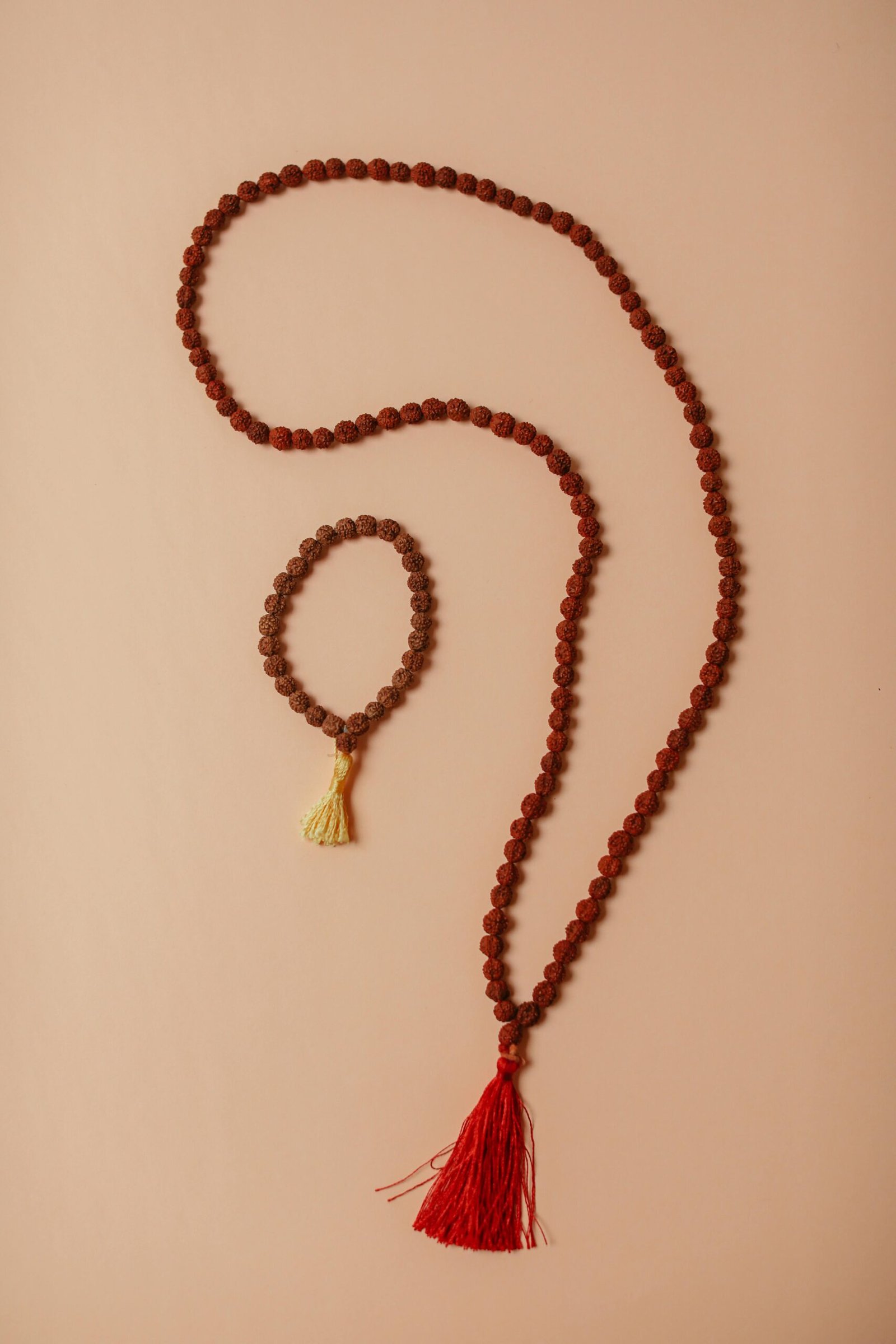
If you do not have a mālā (a string of 108 beads plus one guru bead or a bead count divisible by 108) you may chant without a counting tool, but a mālā is recommended for grounding focus and maintaining the integrity of repetition. Set your attention fully on the deity or on the precise conception you wish to embody.
The choice of deity is not arbitrary. Consider the conceptual design of the deity and the conceptions you wish to invoke to avoid any unintentional consequences. How to chant is for you to play around with, the important thing is consistency throughout a sitting or a single round of a mala. You may whisper (upāṁśu japa), repeat mentally (mānasa japa), or chant aloud (vācika japa).
- There should be a bead with a tuft of loose string, that is the guru bead, you do not count that bead, start with the bead after it. Use your right hand.
- Do not touch mala with the index finger (symbolism of ego). Rest mala on ring finger and use the thumb and middle finger to hold the bead in place as you say the choosen mantra.
- Use middle finger and thumb to move mala to the next bead. You are receiving as you are pulling the mala inward.
- Repeat. When you reach the guru bead do not count it and do not cross it, turn the mala around (without touching with index finger still) and continue if you wish to start a new round.
Here, quantity is as much an even variable as quality. Consistency in number builds a psychic channel, but depth of focus charges it. Push yourself, test your limits, but remain aware of the precision of what you are invoking.
Other Methods and Notes
There is no restriction on biological sex, gender, or ethnicity. Your restrictions and permissions are beyond that.
Prāṇāyāma
A set of different types breath control and breath manipulation techniques. Nadi Shodhana, or alternate nostril breathing, is an effective exercise to calm the mind. There are many levels to this, some even requiring direct guidance from a yoga teacher. Those who are masters of the breath are thus masters of the life force, prāṇa.
Surya Namaskar
In my opinion, the greatest set of stretches one can do. Classically composed of 12 steps, you ideally do this in the morning facing East (sunrise). I usually do it before hitting the gym for any day at any time, it is that good and comprehensive. There are many videos on the internet that will demonstrate how to do it, but be aware there are many variations. It should be relatively simple to do if you are generally fit. Just be sure it ends the same as it begins, with clasped palms in reverence to the Sun. You can be an expert at this one set of motions, it will take you far if it is something that calls to you. Each step also comes with a mantra if you are so inclined to become an expert. Do not forget its created intention, you are aligning yourself with the Solar Deity Surya. Embody those conceptions and illuminate your path forward.
Mantras To Try
Gāyatrī (core verse). Savitur = Sun. To shine with intellect
तत्सवितुर्वरेण्यं भर्गो देवस्य धीमहि ।
धियो यो नः प्रचोदयात् ॥
tat savitur vareṇyaṃ bhargo devasya dhīmahi | dhiyo yo naḥ pracodayāt ||
Mahā Mṛtyuñjaya (Vedic form). Conquer Ends. Knowing Death
त्र्यम्बकं यजामहे सुगन्धिं पुष्टिवर्धनम् ।
उर्वारुकमिव बन्धनान्मृत्योर्मुक्षीय माऽमृतात् ॥
tryambakaṃ yajāmahe sugandhiṃ puṣṭivardhanam | urvārukamiva bandhanān mṛtyor mukṣīya mā’mṛtāt ||
Shorter Mantras – Typical for Japa
Invoke Ma Durga: Feminine Courage, Action
दुर्गायै नमः ॥
durgāyai namaḥ ||
Invoke Lord Shiva: Masculine Witness, The Undisturbed
नमः शिवाय ॥
namaḥ śivāya ||
Invoke Hanuman: Strength. Carry through difficulty.
जय हनुमान ॥
jaya hanumān ||
Invoke Krishna: Bliss. Universal Love and Heart.
वासुदेवाय नमः ॥
vāsudevāya namaḥ ||
Rituals. Blessings. Objects.
Murti’s, beads, gems, and lingams are all good to have, but you are the one responsible for ensuring their power remains. All objects are conceptually interlocked with all of creation, and all are aware in the sense that they are not in stasis, they can take in blessings. Mantras associated with a particular object must be performed with intention and focus for the energy to hold any significant benefit. The number of repetitions depends on how calibrated your body is to implement blessings. It is best to go to an ashram, where structural conceptions are more easily accessible, to have an object blessed by a pandit within their domain. However, if you are practicing regularly, this becomes less of a requirement. If an object is worn purely out of habit, it will not be as effective. Even one small moment before putting it on, or a pause of acknowledgment, is enough to carry its conceptual essence throughout your day.
Care and Authenticity
Seek formal instructions. If you purchase an object, the seller should be knowledgeable about how to care for it spiritually. Be wary of buying things online. If you are serious about authenticity, you must go and understand the object with presence before committing to purchase. It is best not to look for objects, instead the objects will find you. Focus on visiting places of power rather than seeking “objects of power.”
Ritual Practice
Rituals are entirely up to you. The mundane approach is to try different things by attending various events at an ashram or mandir and seeing what resonates. The better approach is to keep doing the basics I have already spoken of. The purification of the body will naturally reveal its conceptual design. All you have to do is listen and respond if something calls out to you. Perhaps nothing will call out, because what you are already doing may be perfect. Sometimes it is through being at the right place at the right time. It is up to the individual to decide what is best for them at this stage. Do whatever feels right. As long as you are doing something, you are one step closer to the truth of your being.
The Three Guṇas: Sattva, Rajas, Tamas
In the material world, all objects, including the human body, are composed of elements categorized as Sattva, Rajas, and Tamas. Behaviors and actions can also be described in these terms, often more concretely than physical objects.
Sattva (Clarity): clean, light, white, stillness, “goodness.” Linked with concentration and the capacity to sustain yogic practice without deviation.
Rajas (Passion): fast, fiery, red, conquest, ambition, rulership. Linked with warrior-like energy and striving.
Tamas (Inertia): heavy, slow, black, dissolution, “foolishness.” Linked with lethargy and decay.
In many traditional teachings, especially around food, there is a tendency to strictly classify what belongs to which guṇa. While useful as a guideline, this can become dogmatic. The truth is that the same food or activity does not affect everyone equally. Each person has a unique conceptual design, and interactions differ based on that design. Coffee might energize one person but make another anxious. Heavy food may slow one person while another digests it easily. Rather than fixed lists, the guiding question should be:
“What do I want out of this?”
If you are going to the gym, rajasic foods may help. If you wish to slow perception and rest, tamasic foods may serve that purpose. If you seek stillness and clarity, sattvic foods support that state. The key is not to fear any guṇa, they are all part of the whole, but to avoid excess.
Too much Tamas can destroy vitality.
Too much Rajas can burn one out.
Too much Sattva can lead to stagnation or what may be called “sattvic ego”, the illusion that one is “good” because of purity practices, even while having no meaningful impact in the world.
There is no need to ban any guṇa outright. Every force has a rightful place in the wholeness of existence. Even a turn toward Tamas can be fruitful when it arises naturally and is navigated with conscious awareness and Dharma. What matters is not suppression but integration. Dharma remains present through all colors, white, red, or black, so long as action is ethical and aligned with one’s deeper design. Awareness transforms each guṇa from a potential trap into a purposeful tool on the path.
Tantra and the Occult
Some things to consider, because there are rules.
Proper Tantra requires initiation. For proper conceptual integration the Parampara, or guru-disciple lineage, must be the thread to your practice. This means someone else, a learned teacher who has a lineage, must observe you and see your fitness for the mantra or ritual they can give you.
Traditionally, you should establish a proper student-teacher relationship, where you can ask questions and see your guru physically. Apparently there are online guru’s, people that will ask for money to give you a mantra, etc. The biggest problem, Tantra is strapping yourself to a rocket. Some play by play advice is useful if you are going down this path. The rocket can take you to the highest conceptions very quickly, or you turn into a fireworks display. I have the same advise for gurus as I do with objects as read above, go to places physically, etc.
Your guru’s instructions for practice becomes imperative, so much so that if you have a guru, then everything I have said in this section when it comes to methods becomes secondary, possibly null.
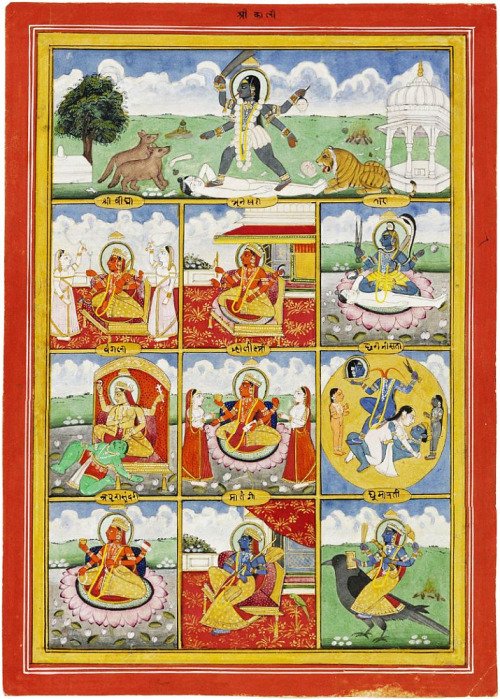
The only reason I am mentioning this is because it is becoming more and more popular. Nonsense I hear people spreading like “Tantra is for everyone”. Nothing is for everyone, and what you are signing up for is important to know. Tantra is usually associated with fierce deities, Ma Kali, Bharava to name a few. Just look at their Vigraha (image) and easily you can see how this path is not for everyone.
If you wish to use Tantra/Occult to gain wealth, love, power, or protection, that is your choice. The gods respond. To invoke a conception is to enter into a living exchange and nothing in the subtle or gross realm comes without balance. Just understand the cost.